SB updates
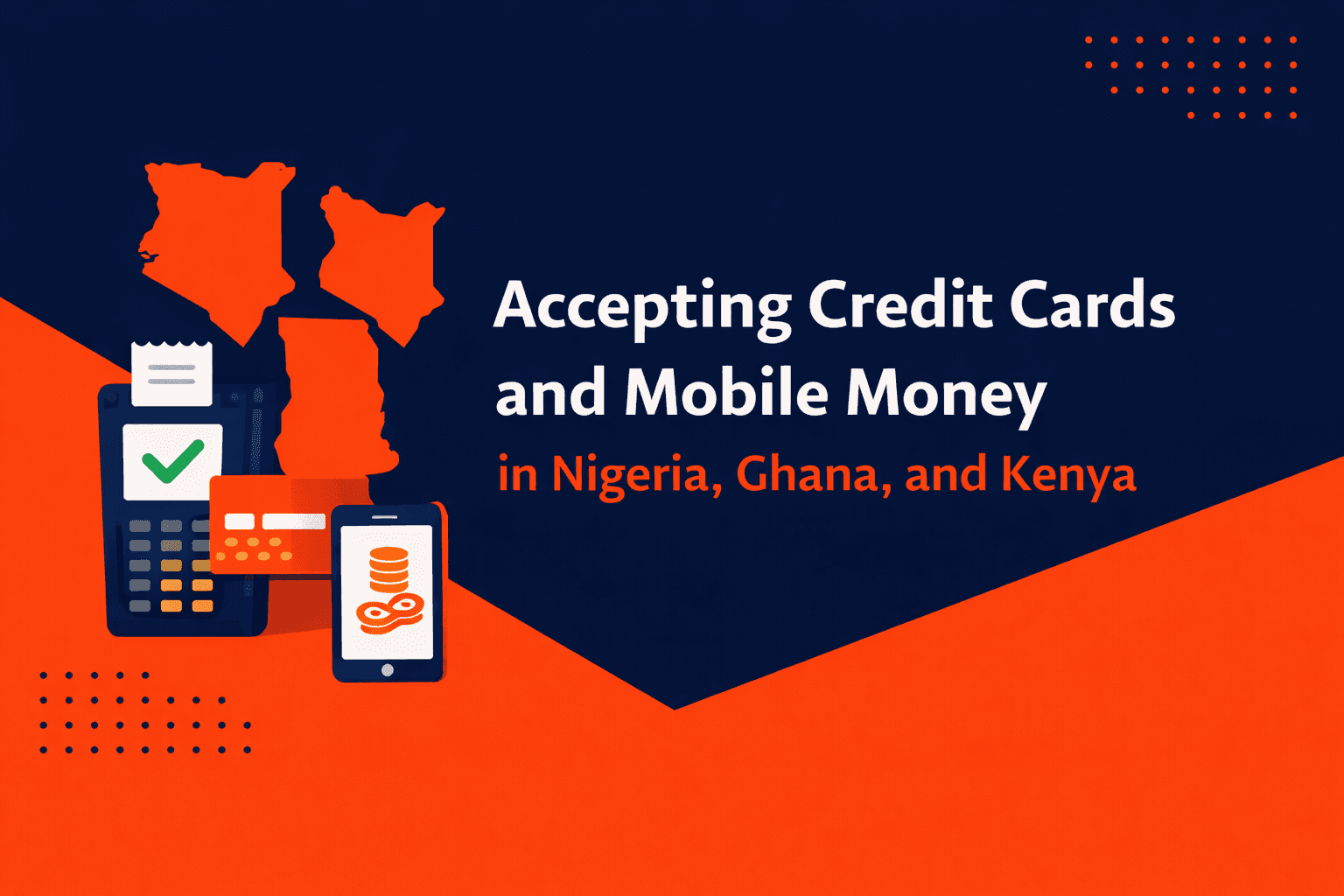
Accepting Credit Cards and Mobile Money in Nigeria, Ghana, and Kenya
Damilola Oyelere
Feb 25, 2026
3 minutes
A reality check most payment guides won't give you upfront: Africa doesn't have a payment problem, it has a payment complexity problem, and trust that there's a meaningful difference between the two.
Mobile money penetration in Kenya hit 91% in 2025, Nigeria processed NGN 1.56 quadrillion in electronic transactions in the first half of 2024 alone, and Ghana recorded its highest-ever monthly mobile money volume, GH¢ 518.4 billion, in December 2025. These aren't emerging markets dipping their toes into digital commerce. They're live, high-volume economies with sophisticated payment rails and consumers who transact digitally every single day.
The problem is that each market runs on different infrastructure, different regulations, and different consumer behaviors, and navigating all three simultaneously, without the right architecture underneath you, is where most foreign businesses quietly fail.
This is a guide to doing it right.
The first decision that determines everything else
One foundational decision you need to make before anything else is to determine if you are going to be the legal seller in each market, or if you are going to work with someone who already is.
This is the difference between a Payment Service Provider (PSP) and a Merchant of Record (MoR), and it's not a subtle distinction.
A PSP like Paystack or Flutterwave is a technical gateway. It moves money efficiently and provides solid APIs. When you use a PSP, you remain the legal seller; that means you own every tax obligation, every VAT filing, every chargeback dispute, and every compliance requirement in every country where your customers live. For a business with a local entity, a dedicated finance team, and established relationships with local tax advisors, that's manageable. For a business trying to move fast across three markets simultaneously, it's a full-time operational burden that has nothing to do with your product.
A Merchant of Record like Startbutton steps in as the legal seller on your behalf. When a customer in Lagos or Nairobi makes a purchase, the MoR is the entity that appears on their bank statement, handles the tax calculation, remits VAT to the local authority, and assumes liability for fraud and chargebacks while you stay focused on the growth of the product. The MoR handles the regulatory infrastructure that sits around every transaction.
PSP | Merchant of Record | |
Legal Seller | Your business | The MoR |
Tax responsibility | You calculate and remit | MoR handles everything |
Setup time | Weeks to months | 24–48 hours |
Chargeback liability | Your problem | MoR's problem |
Local entity required | Usually | You have to be registered in a country |
The choice isn't about which model is universally better. It's about which model fits the current stage of your business, which determines when you should expand your business. If you're validating demand in a new market before committing to local incorporation, the MoR path is almost always the faster and cheaper way to find out if the bet is worth making.
Nigeria
Nigeria's scale is genuinely difficult to overstate. The e-commerce market is projected to reach $10.5 billion by 2028, and the CBN's cashless policy push has moved the country to a point where digital transactions are no longer an additional form of transacting, but Nigeria will expose the gaps in its payment infrastructure faster than any other market on the continent because of its volatile currency. Here's what you need to know before you launch.
Verve is the king of every payment method. In most global markets, Visa and Mastercard dominate the markets, but in Nigeria, Verve, which is a domestic card scheme owned by Interswitch, accounts for approximately 65% of all issued cards and transaction volumes. Its dominance is rooted in deep integration with microfinance banks and cooperative organizations that serve the populations most international platforms are trying to reach. If your checkout doesn't support Verve, you're functionally invisible to the majority of the Nigerian market.
The fintech layer is massive and growing; OPay, PalmPay, and Moniepoint processed NGN 71.5 trillion in 2024, a 53.4% year-over-year increase. Nigerian consumers have developed a strong preference for fast, mobile-first interfaces that operate with lower friction than traditional banking apps; your payment experience needs to meet that expectation.
The regulatory environment is shifting in real time. As of February 2026, the NGN 50 stamp duty on electronic transfers has been restructured so the sender, not the receiver, bears the cost for transfers of NGN 10,000 and above. For merchants, this means the amount sent is now the exact amount received, which simplifies reconciliation but requires your systems to simply reflect the updated fee so you won’t run at a loss. The Nigeria Tax Act 2025 also introduced Significant Economic Presence (SEP) rules that create tax obligations for non-resident digital businesses once they cross NGN 25 million in annual Nigerian revenue, a threshold that meaningful traction will exceed soon.
Ghana
Ghana has built something genuinely impressive, which is a mobile money infrastructure where funds move in quickly, 24/7, across different networks and between mobile wallets and bank accounts. Over 26.7 million active mobile money accounts, settlement happens instantly, and a regulatory environment that is actively formalizing how money flows into and out of the country.
For merchants, Ghana is one of the most technically accessible markets in Africa once you understand how it works.
The Ghana Interbank Payment and Settlement Systems manages the Mobile Money Interoperability service that makes cross-network transfers possible. This infrastructure is what allows a customer on MTN to send money to a merchant on Telecel without friction. For platforms collecting payments from Ghanaian consumers, integrating with this infrastructure rather than trying to build bilateral relationships with individual mobile network operators is the only path to real market coverage.
The December 2025 IMTO guidelines changed the rules for cross-border flows. The Bank of Ghana issued new regulations for International Money Transfer Operators that are strict and specific. Inward remittances must be settled in Ghanaian Cedis through approved agent banks. IMTOs are now confined exclusively to inward, person-to-person transfers and cannot conduct outbound transactions. Licensing also requires a 90-day process with detailed ownership disclosures.
For a foreign merchant collecting payments from Ghanaian customers, these rules mean your payment infrastructure needs to be operated by someone who already has the approved banking relationships and understands the cedi settlement requirements. This is not a DIY compliance situation for a business that is new to the system.
Kenya
Kenya is the reference point most people use when talking about mobile money in Africa, and for good reason. M-Pesa processed KSh 38.29 trillion, approximately $292 billion, in 2025. Mobile penetration sits at 146% due to multi-SIM ownership. This infrastructure has been tested and exceeded expectations for nearly two decades
Although Kenya in 2026 is not the same story as it was five years ago, three major developments define the current market.
M-Pesa's market share fell below 90% for the first time in late 2025, with Airtel Money reaching 10.3% through aggressive agent network expansion and competitive pricing. For merchants, this is good news; more competition means lower transaction costs and better interoperability, but it also means your payment infrastructure needs to support both networks, not just the dominant one.
The Central Bank of Kenya is targeting lower costs and has set a target of reducing the average mobile money transaction cost from KES 23 to KES 10 by 2028. This involves price caps and the potential introduction of a Unified Payments Interface modeled on India's UPI system. For merchants, the direction is toward cheaper, faster, more interoperable transactions, and building your payment stack in alignment with that direction now positions you well for where the market is heading.
Crypto and stablecoins are entering the mainstream, too; Kenya passed the Virtual Assets Service Providers Act in October 2025, creating a formal legal framework for cryptocurrencies and stablecoins. M-Pesa is already exploring blockchain integration for cross-border settlement. For merchants dealing with international suppliers or paying out to partners across multiple currencies, stablecoin settlement options are shifting from experimental to practical.
Kenya also carries some of the continent's most rigorous tax enforcement. The Kenya Revenue Authority (KRA) eTIMS platform requires real-time e-invoice submission, and the 3% SEP tax applies to all digital service income from Kenyan users, with no turnover threshold for non-residents. If you have Kenyan customers, you likely have a Kenyan tax obligation regardless of where your entity is registered.
What good payment Infrastructure actually looks like
Across all three markets, the technical requirements for a merchant who wants to operate seriously meet around the same needs.
Multi-rail support through a single integration. Verve in Nigeria, MTN MoMo and Telecel in Ghana, M-Pesa and Airtel Money in Kenya, plus bank transfers across all three markets. Building these integrations separately is a significant engineering task; maintaining them as APIs evolve and regulations shift is worse than ever.
The argument for a single orchestration layer that handles all these localized payment methods across all three markets isn't just about launch speed; it's about long-term technical debt.
Auto-conversion to hard currency, earning NGN, GHS, or KES, and holding those balances exposes your margins to currency risk that is real and recurring. The ability to auto-convert local currency proceeds to USD or USDT the moment a transaction is marked successful is not a premium feature for large enterprises; it's a basic margin protection mechanism for any business operating across African markets.
Transaction status clarity, managing delivery risk across multiple markets, requires understanding exactly where a payment sits in its lifecycle at any given moment. The difference between a payment that is verified — confirmed by the partner, safe to release goods against — and one that is merely pending is operationally critical, particularly for digital goods where delivery is instant and reversals are painful.
Security and KYC that meet local standards. Nigeria's BVN-anchored identity verification, Ghana's consumer protection requirements, and Kenya's increasingly rigorous AML standards all require different compliance approaches. An MoR that handles these requirements as part of its standard infrastructure removes an entire layer of ongoing regulatory work from your team.
The bottom line
Nigeria, Ghana, and Kenya collectively represent some of the most dynamic consumer markets on the planet right now. The consumers are digital, the payment infrastructure is real, and the demand for well-built products is genuine.
What separates the businesses that scale in these markets from the ones that stall is rarely the product. It's the infrastructure decisions made before the first transaction. Choosing payment rails that actually reach your addressable market. Building compliance into your architecture rather than bolting it on after the fact. Protecting your margins from currency volatility before it becomes a problem.
The merchants that will define this next chapter of African commerce are the ones who treat payment infrastructure as a strategic layer, not an afterthought. The complexity is real, but it's navigable, and the market on the other side of that complexity is worth every bit of the effort.