SB updates
Nigeria’s New ₦50 Stamp Duty & 2026 Tax Reforms: What Businesses Need to Know
Daniel Adeyemi
Feb 17, 2026
3 mins
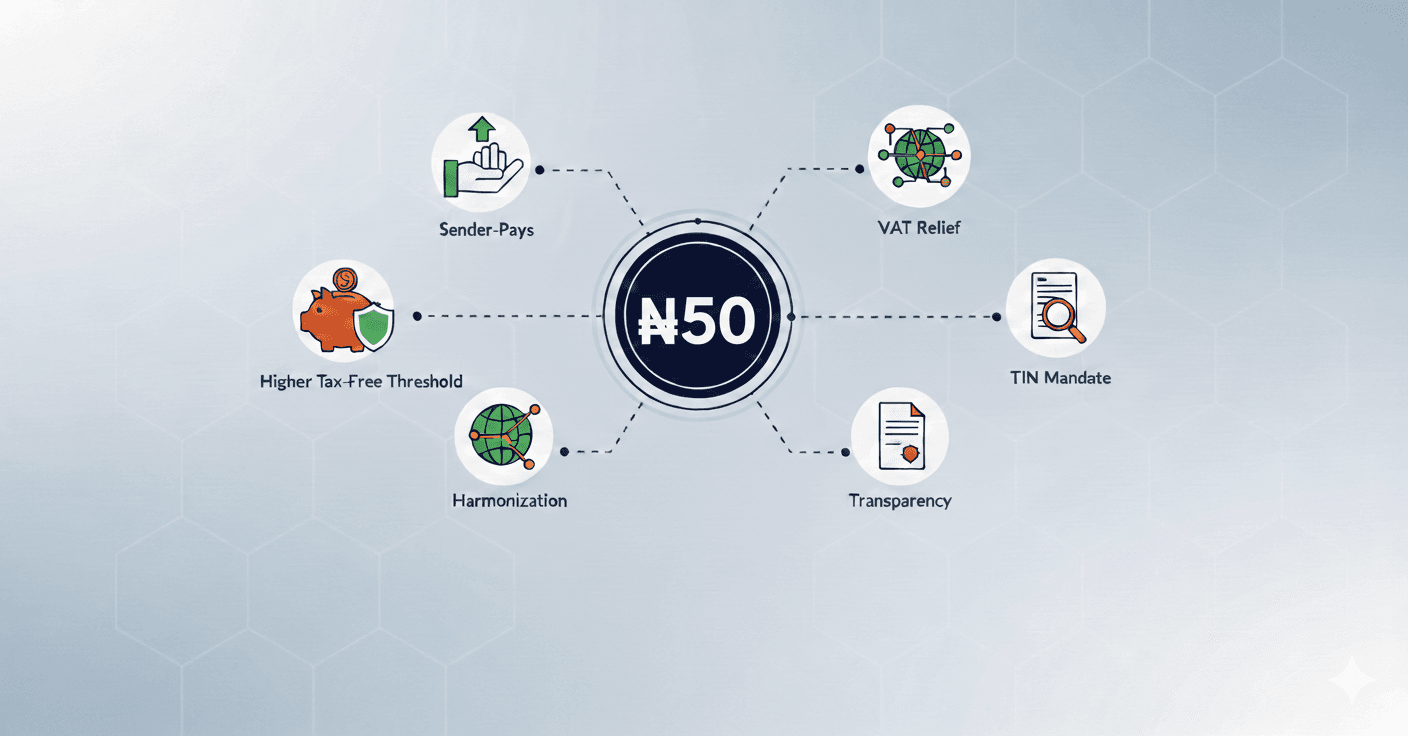
If you’ve checked your banking app or received a transaction alert lately, you’ve likely seen a small, persistent guest: the ₦50 Stamp Duty. While fifty Naira might feel like loose change, its recent restructuring—effective January 1, 2026—is a major signal of where Nigeria’s tax system is headed.
At Startbutton, we believe that understanding the "why" behind your bank charges is just as important as managing the balance itself. This isn't just about a ₦50 fee; it’s a piece of a much larger puzzle called the Nigeria Tax Act 2025.
Here is what you need to know about this charge, why the rules of the game just changed, and how it fits into the broader tax reforms.
What exactly is the New ₦50 charge?
The charge, officially known under the new laws as a "Stamp Duty" (incorporating what was previously the Electronic Money Transfer Levy or EMTL), is a one-off ₦50 fee applied to electronic transfers of ₦10,000 and above.
However, there is a massive shift in who pays it.
The Sender now pays
Before this latest update, the ₦50 was typically "the receiver's problem." If someone sent you ₦20,000, you’d receive ₦19,950. As of 2026, the script has flipped. The sender now bears the cost. If you are sending ₦10,000 to a friend, your bank will deduct ₦10,050 from your account. This change aims to provide "transactional finality" for the receiver—when you are sent a specific amount, that is exactly what you get.
Quick Tip: What’s Exempt? Not every transfer is taxed. You don't have to worry about the ₦50 charge for:
Transfers below ₦10,000.
Salary payments (so your hard-earned pay stays intact).
Intra-bank self-transfers (moving money between your own accounts in the same bank).
Why is this happening?
To understand why the Federal Inland Revenue Service (FIRS) and the Nigerian government are focused on the Electronic Money Transfer Levy (now Stamp Duty), you have to look at the Nigeria Tax Act 2025.
For decades, Nigeria’s tax landscape was a "jungle" of over 60 different taxes and levies. The new reforms are pruning that list down to a handful of core taxes. The Stamp Duty is part of this "cleanup." By renaming and restructuring the EMTL into a formal Stamp Duty, the government is creating a unified, digital-first revenue stream that is easy to track and hard to dodge.
What it means for You
For the average Nigerian, the ₦50 charge is a "social contract" fee. While nobody likes extra charges, the 2026 reforms have actually balanced this out with some significant "wins" for your pocket:
Higher Tax-Free Threshold: If you earn ₦800,000 or less per year, you are now completely exempt from Personal Income Tax.
VAT Relief: To offset the cost of living, the government has removed VAT from essential items like basic food, healthcare, and education.
Transparency: Because the ₦50 is now charged at the point of sending, it’s much easier for you to track your actual spending without doing "receiver's math."
What it means for Businesses
If you run a business, this change is a double-edged sword, but it mostly leans toward better accounting.
1. Cleaner Bookkeeping
Since the receiver no longer bears the charge, business owners can reconcile their accounts more easily. If a customer pays for a ₦50,000 product, the merchant sees exactly ₦50,000 in their ledger. No more messy "off-by-fifty" balances at the end of the month.
2. The TIN Mandate
Under the new Tax Administration Act, having a Tax Identification Number (TIN) is no longer "optional" if you want to play in the formal economy. Banks and fintechs are now required to link transactions to TINs. For businesses, this means the ₦50 Stamp Duty isn't just a fee—it’s a digital footprint of your commercial activity.
3. Small Business Protections
The wider reform actually favors small businesses. If your annual turnover is under ₦50 million, you are now exempt from Companies Income Tax (CIT). In the government's eyes, the ₦50 Stamp Duty is a way for small businesses to contribute to national revenue without being crushed by the heavy corporate tax rates that the "big players" pay.
Why the "Sender-Pays" model matters
The shift to the sender paying is a psychological and economic masterstroke for the digital economy. In the past, the "receiver-pays" model often led to disputes between customers and vendors ("I sent ₦10,000, why did you only get ₦9,950?"). By moving the cost to the sender, the responsibility of the transaction cost stays with the person initiating the action.
It mirrors how we handle physical logistics: if you ship a package, you pay the courier. The same logic now applies to shipping digital money.
The bottom line
The ₦50 Stamp Duty is the "entry fee" for a more organized Nigerian economy. While it feels like a minor annoyance, it is part of a reform package that is:
Exempting the poor from income tax.
Removing VAT from bread, medicine, and school books.
Modernizing how we track wealth and business growth.
At Startbutton, we’re keeping a close eye on these changes to ensure you’re always a step ahead. Taxation might be inevitable, but being caught off guard doesn't have to be.
Frequently Asked Questions (FAQ)
1. Who pays the 50 Naira stamp duty in 2026? Under the new reforms, the sender of the money pays the ₦50 fee, not the receiver.
2. What is the minimum amount for 50 Naira stamp duty? The charge only applies to electronic transfers of ₦10,000 and above.
3. Are salary payments exempt from stamp duty? Yes, salary payments and transfers between your own accounts in the same bank are exempt from the ₦50 charge.