Business tips
How Mobile Money Works in Francophone West Africa: MTN Momo, Wave, Orange Money
Olasubomi Oduntan
Aug 10, 2026
6 minutes

Ask your payments team about mobile money in Africa, and you'll most likely hear one word: M-Pesa. They're not wrong, but they're talking about what works in Kenya. When they cross into Francophone West Africa, M-Pesa is nowhere. The wallets that matter are Wave, Orange Money, and MTN MoMo. Launch there without them, and you haven't built a checkout. You've published a webpage.
In this article, we will discuss who the players are in Francophone Africa, their strengths, and what they mean for how you process payments.
Top 3 Dominant Mobile Money Platforms in Francophone West Africa
There is no single “mobile money” integration for Francophone West Africa. Covering the region means you support multiple wallets and prioritize per country. These are the top 3 mobile money platforms in the francophone region:
Wave: Wave was launched in Senegal and was considered a disruptor when it entered the market. Their proposition was dramatically cheaper transfers (free deposits and withdrawals, and a low flat-percentage transfer fee). They built a massive agent network and a very simple-to-use app. This made users in Senegal switch to the platform in droves, and Wave became one of Francophone Africa’s biggest consumer-fintech stories. Their market entry also forced the sector leaders across the region to slash their fees. Wave is stronger in Senegal and Côte d’Ivoire, with expansion across other WAEMU markets.
Orange Money: Orange is the biggest mobile money player in Francophone Africa. They have the longest history (due to their telecom footprint across the region), the deepest regional coverage, and entrenched habits in users’ lives. Salaries, bills, and remittances have flowed through Orange Money for over a decade. Where Wave isn’t concentrated (e.g. Dakar and Abidjan), Orange Money is usually the default.
MTN MoMo: MTN Mobile Money has penetrated most of the continent. This is mostly due to the quantity of MTN’s subscriber base. Within WAEMU, it operates only in Côte d'Ivoire and Benin. There is no MTN wallet in Senegal, Mali, Burkina Faso, or Niger.
Who leads where?
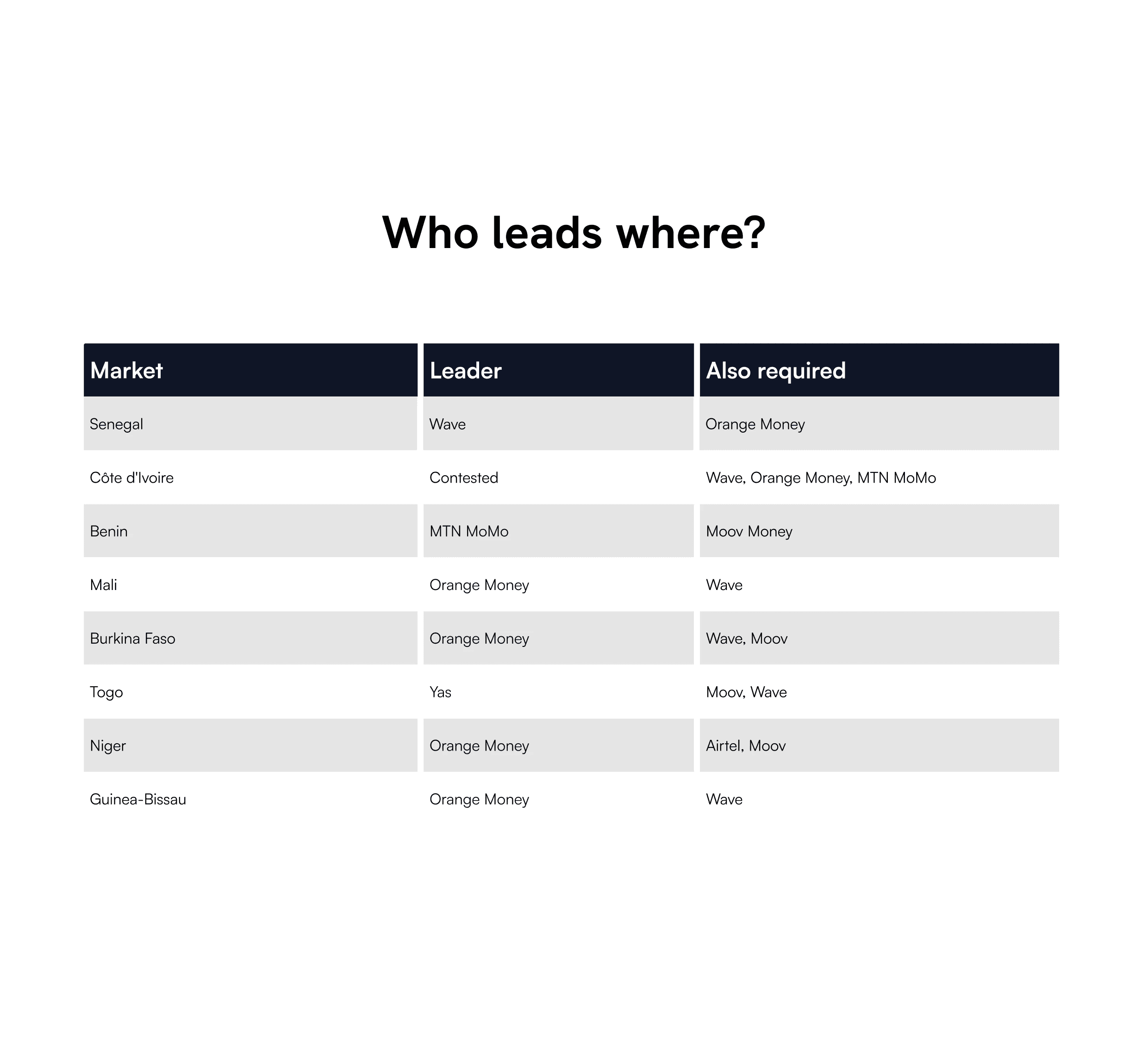
Côte d'Ivoire is the market most merchants reach for first and the one where the ranking is least settled. Published estimates for 2026 disagree on whether Wave or Orange Money leads the market. Picking one wallet means a coin flip for the majority of your customers, so build for all three.
Two things worth registering. Senegal is now the largest mobile money market in the bloc, accounting for 24.1% of WAEMU transaction volume, ahead of Côte d'Ivoire and Benin, each at 21.4%. And since 30 September 2025, P2P transfers between connected institutions are instant and free across all eight WAEMU countries. This raises how much value runs through the rails, which makes absence from them more expensive every quarter.
How do Payments Work in Francophone West Africa?
For a customer paying a business with mobile money, the process is quite straightforward. At checkout, they choose their preferred wallet, receive a prompt on their phone (either through the app or USSD), confirm with their PIN, and the payment is complete. There's no need to type in a card number, remember a CVV, or go through multiple authentication screens.
What you need to understand the most is how money gets into the wallet in the first place. Most users in the region don’t link a bank account to their wallet. This is because a large number of the population is unbanked. Because they don’t have a traditional bank account or debit card, they cannot fund their wallets through an app transfer or online link. Instead, they visit a nearby mobile money agent, hand over cash, and the agent credits their wallet balance. This network of agents is what makes mobile money work.
This is also why mobile wallets are more prevalent in the francophone region than traditional bank accounts. Wallet adoption is proportional to agent density in each street, and the more they are in an area, the easier it is for people to access and use mobile money.
For finance teams, there are two things you should keep in mind:
Each wallet has its own fees and settlement process: Wave, for example, became popular because of its low consumer fees. However, merchant fees, settlement timelines, and payout methods vary between providers and markets. You should evaluate each provider individually instead of making the assumption that they all work the same way.
Payments are settled in XOF: Across most of Francophone West Africa (WAEMU), mobile money payments are settled in the West African CFA franc (XOF). The currency is pegged to the euro, so businesses don't face the same exchange rate volatility that’s present in some other African currencies. If your company operates across the region, this can make cash flow more predictable. We covered more of this in our WAEMU expansion guide.
What does this mean for your conversion rate?
The number of people paying with cards in francophone West Africa is low. Most people pay with mobile wallets. Therefore, a checkout that only accepts card payments shuts out a large share of willing customers. Even if you support mobile money, choosing the wrong wallet for a market can still lead to friction and abandoned purchases.
What should you do, instead?
Lead with the wallet people already use in the market: Customers are more likely to complete a purchase if they see a payment method they’re familiar with and can trust. For example: Wave in Senegal and Côte d'Ivoire, MTN MoMo in Cameroon and wherever MTN already has a large customer base, etc.
Put the most popular local wallet first, rather than treating them all the same.
Don’t rely on just one wallet: While some customers are loyal to one wallet, some others have accounts with multiple wallets. Supporting at least two wallets gives your customers a choice and increases your chances of completing a sale.
Design your checkout UX around how mobile money works: Mobile money payments are different from card payments. Customers are usually required to complete the payment process by approving a prompt on their phone (either their app or USSD). Your checkout should fit into that flow. A simple message like “check your phone to approve this payment” can reduce confusion. It's also important to give customers enough time to respond instead of showing an error if approval takes a little longer.
Measure performance wallet by wallet: Not every failed payment is caused by the same reason. One wallet might have more failed transactions because customers have insufficient wallet balance; another could have PIN timeouts or expired prompt requests. Tracking and analyzing completion rates of each wallet separately helps you identify where customers are dropping off and what’s causing the drop-off, so you can fix the actual problem.
Read also: How to collect mobile money payments in Africa
A single integration instead of multiple partnerships
If you wanted to support the major wallets in Francophone Africa, you would need to negotiate separate commercial agreements, build separate integrations, and manage separate settlement relationships for each of the providers (likely in each country). Not only that, but you would also need to navigate licensing requirements, BCEAO (the overseeing regulator), and French-language documentation.
This is where Startbutton comes in. Instead of managing all these mobile money partners in each francophone country, you integrate with Startbutton once. We give you access to the mobile wallets your customers already use, while also handling the operational layers behind the scenes. We handle the local licensing, tax, and compliance, while you focus on building your product.
Mobile money is a major payment rail in Africa. As adoption continues to grow in francophone West Africa, businesses that support the right local payment methods will win.
If you're planning to expand into African markets, Startbutton can help you do it without building your local payment infrastructure from scratch.
Startbutton is a Merchant of Record that helps businesses sell across Africa through a single integration. Join more than 200 businesses using Startbutton to simplify expansion into African markets. Get started here.